
Every large society lives inside recurring dramas. Characters and issues change, but underlying mechanics remain.
Periods of stability give way to periods of strain. Assumptions that once held begin to weaken. Questions thought resolved quietly return. When enough of these pressures surface at the same time, a society reaches an inflection point — not a collapse, not a revolution, but a moment when direction becomes uncertain again.
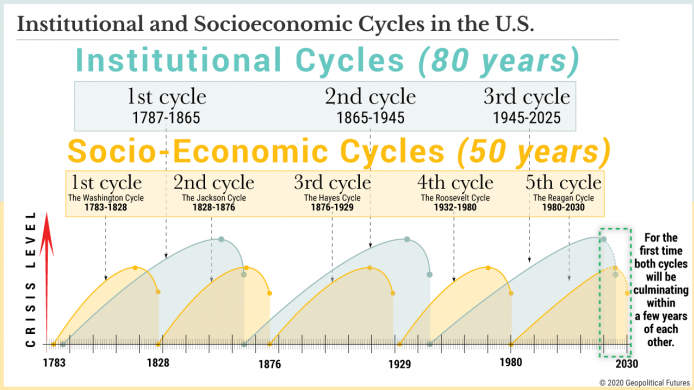
This is where the United States finds itself now. Not because of one election, one court case, or one cultural conflict — but because multiple systems are being stressed at once.
Periods of instability become inflection points when multiple pressures converge.
This year, long-building stresses coincide with a national anniversary that compresses narratives about identity and purpose, and with midterm elections that set institutional direction without the clarity or attention of a presidential cycle.
These conditions don’t dictate outcomes. They make direction more consequential.
History does not move in a straight line. It moves through repeating tensions:
• authority and legitimacy
• law and culture
• individual conscience and collective rules
• restraint and power
These tensions never disappear. They cycle in and out of prominence as conditions change and generations inherit institutions they did not design.
What feels like chaos up close often looks, in hindsight, like a familiar pattern:
a period when alignment between values, institutions, and authority thins — and eventually re-forms in a different configuration.
Cycles are not destiny.
They are recurring tests.
Individual issues often draw attention during these moments, but they are rarely the cause. They are signals — places where deeper misalignments become visible.
One example many people recognize is abortion. A Supreme Court decision in the early 1970s reflected the prevailing ethos among those positioned to decide at that time. For some, that decision represented a step forward. For others, it did not. The unresolved pressure persisted, organized, and eventually led to a repositioning of authority decades later, with far-reaching consequences. *
The point here is not the issue itself.
The pattern matters more than the specific issue.
Decisions tend to reflect the ethos of those in the seats at a given moment — not the full range of views within the society. Competing views do not vanish. They accumulate, adapt, and wait for conditions to shift.
This dynamic appears repeatedly, across various issues, eras, and ideologies.
Moments like this are difficult to recognize because nothing is absolute. Institutions continue to function. Daily life goes on. Disagreement is real but incomplete. Many people feel partial dissatisfaction without feeling compelled — or equipped — to act on it.
This is not apathy.
It is the cost of complexity.
Large systems persist without consensus. Pressure builds unevenly and often invisibly. Most people adapt rather than confront, not because they are indifferent, but because navigating ambiguity requires effort, time, and attention. Cycles rarely turn because clarity arrives. They turn because ambiguity becomes unsustainable.
Periods of institutional stress rarely arrive quietly. They are accompanied by surges of urgency, anger, and moral certainty — amplified by media systems that benefit from constant engagement. New targets emerge daily. Attention is pulled from one outrage to the next before understanding can settle.
This does not mean the moment is unprecedented. It means pressure is being expressed without a stable reference point.
When anger is untethered from shared standards, it moves continuously. Yesterday’s issue is replaced by today’s before judgment can accumulate. Reaction begins to substitute for responsibility. The result is exhaustion rather than clarity.
For many people, this creates a quiet tension: life still must be lived — families supported, work done — yet the surrounding noise suggests that failing to respond to everything is itself a failure.
This is the condition in which orientation matters most.
Direction does not change all at once, and it is not shaped by noise alone.
It shifts when:
• cultural assumptions change
• institutional positions are occupied by people with different priorities
• long-standing pressures finally outweigh inherited arrangements
Who sits in the room matters.
What they believe matters.
What they take for granted matters.
Over time, alignment between ethos and authority determines which questions are reopened, which compromises hold, and which do not.
The citizen’s question
Are your values, concerns, and assumptions meaningfully represented by those making decisions — or are you outsourcing your thinking to habits, teams, or noise?
Are the rules, structures, and tradeoffs clear enough to you to know the difference?
Inflection points do not require certainty.
They require orientation.
History will move with or without your attention.
The only open question is whether you recognize where you are — while direction is still being shaped.
We inherited a mission—not a finished product.
The Preamble laid out the work: justice, peace, defense, shared well-being, liberty—for all.
The Constitution is the tool to pursue that mission.
But tools only matter if we know what they’re for—and are willing to use them.
That’s where we come in. Thinking isn’t extra—it’s the engine.
We do better when we think. That’s the deal.